Light waves
The methods of the information spying are based on the usage of the
physical effects at the production, the assignment, the reinforcements
of the light signals until the reception and the following
transformation in electrical signals.
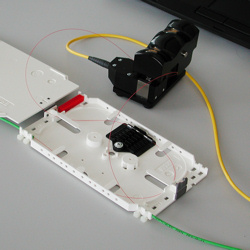 The photons move tangentially within the light wave conductor in the
axis of the light wave conductor. By LED producing spreads within the
fibre or by the photons these ray bundles are also widened. Through this
photons also reach the outer limits of the fibre. Since the fibre is not
in an axial exact system, the photons are reflected by the limits (edge)
of the fibre.
Depending on the reflection coefficient these are reflected and shone
back into the fibre. Other photons leave the fibre and can further be
processed.
They read the article also to this in Wikipedia glass fibres
Photons can this leave the fibre depending on the composition. Are on
pressed on the fibre, a second fibre with the same breaking qualities,
the first fibre succeeded in photons relatively undampedly into the
second fibre so. It depends on a number of factors how large the degree
of effectiveness of this coupling is. Or a part of the photons is
diverted into the second fibre now and is not any more with that at the
real receiver's disposal, said differently.
The "additional recession" arising from this decoupling can lead to
instabilities of the assignment under circumstances. Particularly then
if you work in the lower sensitiveness area of the optical sensor.
On the other hand the case can this occur, they notice absolute
nonentity, since the reception system this reduced input signal
ausregelt.
 In principle, applies to the attack on a fibre optic system:
E empf = E E send - muffle - E decouples a lower limiting value is for E
empf > E empf
E empf = reception energy at the sensor; E send energy of the LED =; E
muffle line attenua
tion =;
E decouples energy losses = by the decoupling facilities
































 Translation to the illustration