plug panel
The following description of the cryptographic functionality of these
Component is left to the experts, Dr. Miller.( .... )
Nothing else on the machine which could be used to set the
initial state of the cryptologic was variable. Additional necessary
equipment included a mechanical system (stepping levers and
ratchets) for forcing rotor rotation, a twenty-six-letter keyboard,
twenty-six light bulbs for the output letters, and a battery for
powering the light bulbs.What we wish to determine is the number
of different ways of configuring the variable components in the
system which contributed to the cryptographic strength of the
machine. Although in practice the Germans did not use Enigma to
its fullest potential, Allied cryptanalysts could not a priori rule out
any valid theoretical configuration.
The first variable component was the plugboard.Twenty-six (for
A-2) dual-holedsocketswere on the front panel of Enigma. A dual-
wired plugboard cable could be inserted rnalung a connection
between any pair of letters. Enigma cryptographers had a choice of
how many different cables could be inserted (from zero to thirteen)
and which letters were connected. Tke plugboard functioned like an
easilymodifiablestationaryrotor positioned to the right of the three
rotating rotor^.^
There were three elements which must be considered when
calculating the number of possible plugboard connections: the
number of cables used, which group of sockets was selected to
receive those cables, and the interconnections within that group of
sockets (i.e.,the specificletter-pairs createdby each cable). We will
consider socket selection first. There were twenty-six socketson the
plugboard. Each individual cable consumed two sockets (one for
each end of the cable). Given the choice ofp plugboard cables (0I
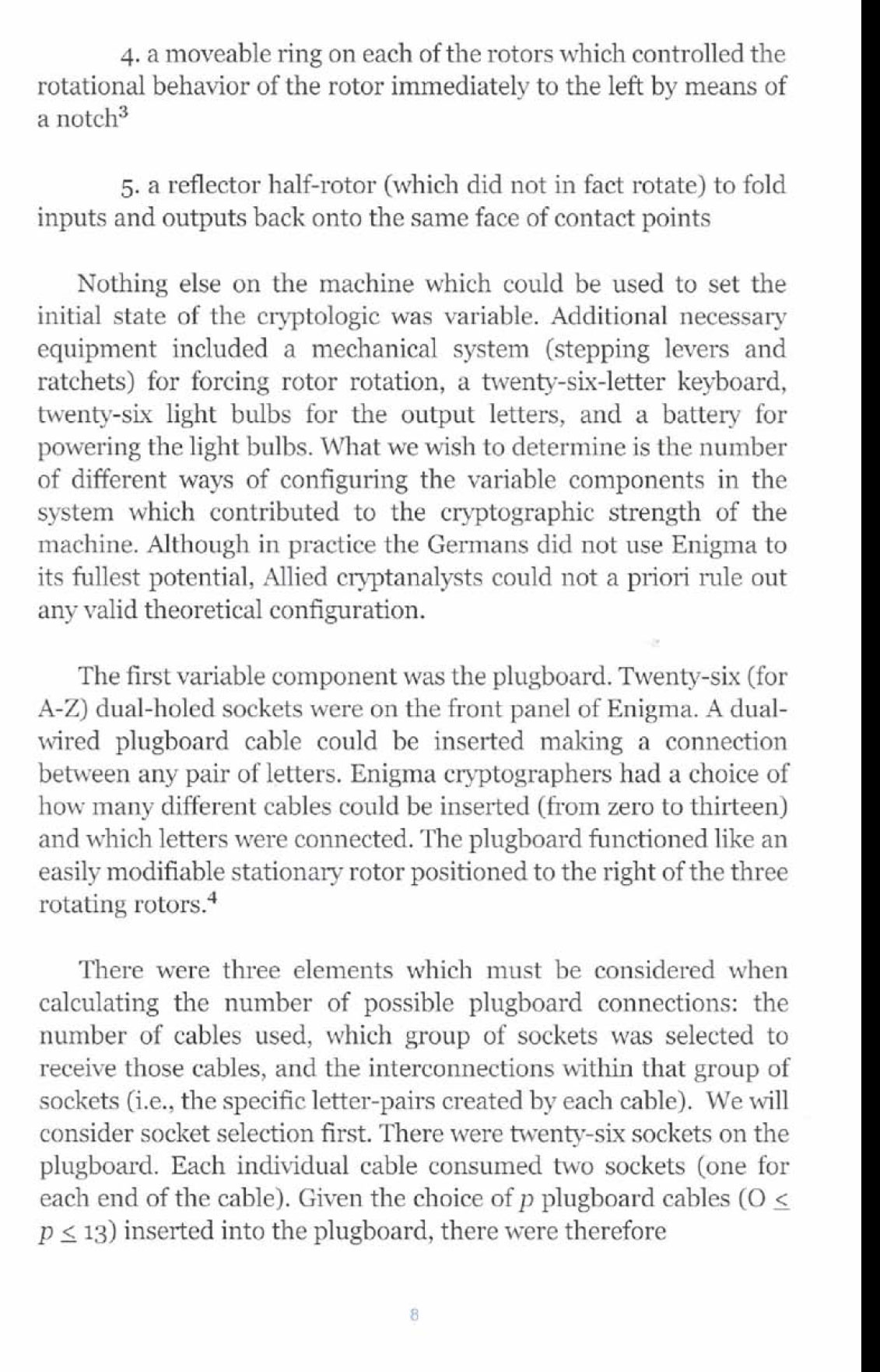
p I13) inserted into the plugboard, there were therefore
different combinations of sockets which cloud have been 7 r
selected.
Formel
Having calculatedthe numkr of differentgroups of sockets, we
will now determine how many ways in which those p cables could
have been inserted into the 2pselected sockets.Mer the first end of
cable #I was inserted into a socket, the second end of the first cable
had 2p -1 free sockets from which to choose (within that group).
After the first end of cable #2 was inserted into a socket, the second
end of the second cable had 2p -3 free sockets from which to
choose. This pattern continues down to cable #p; when its second
end needed to be inserted into the plughard, only one free socket
was left open. It should be dear at this point that the total numkr
of ways in which p cables5 could have been inserted into ap open
sockets (with each cable consuming two sockets) is given by the
equation (zp-I)X (2p-3)X (2p-5) X... X I.
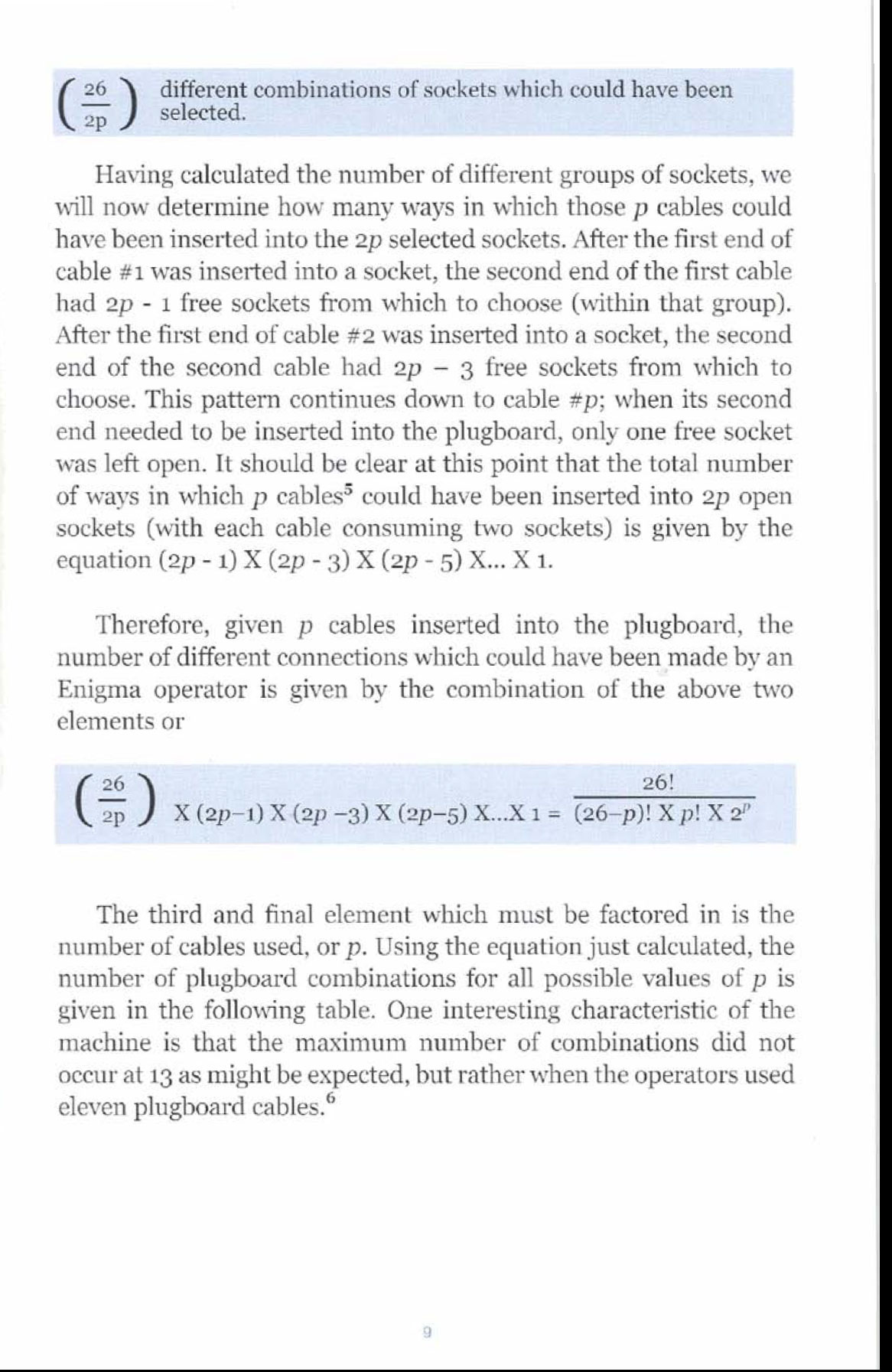
Therefore, given p cables inserted into the plugboard, the
number of different connections which couldhave been made by an
Enigma operator is given by the combination of the above two
elements or
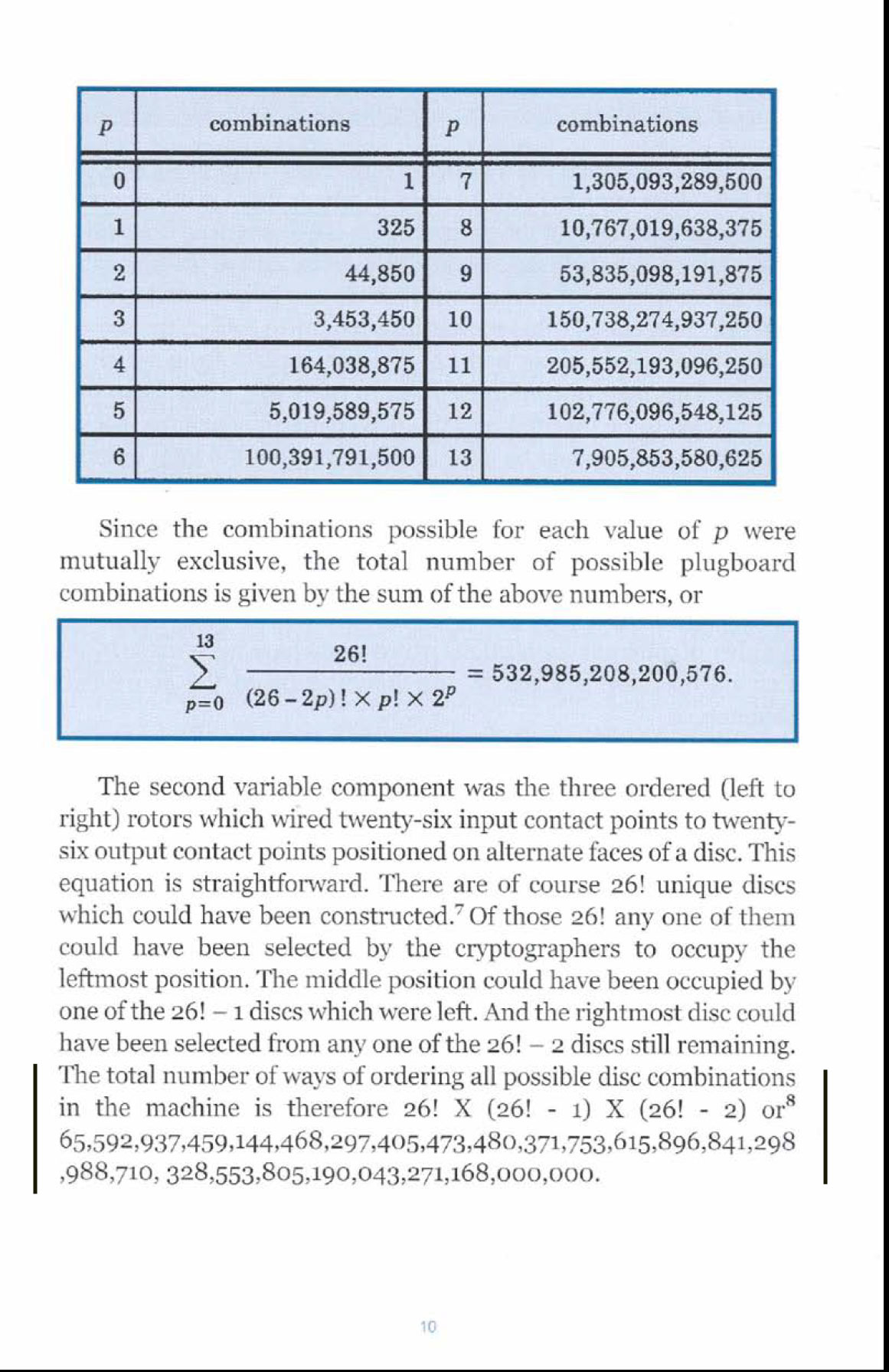
The third and final element which must be factored in is the
number of cables used, or p. Using the equationjust calculated, the
number of plugboard combinations for all possible values of p is
given in the following table. One interesting characteristic of the
machine is that the maximum number of combinations did not
occur at 13as might be expected,but rather when the operators used
eleven plugboard cable^.^
mmbinations combinations
Since the combinations possible for each value of p were
mutually exclusive, the total number of possible plugboard
combinationsis given by the sum of the above numbers, or
( .....)